The second expansion of the original Aswan Dam extended the impounded Nile waters up the Nile to the Sudanese border, and made it necessary to undertake a second archaeological survey of Nubia between 1929 and 1934. This operation, supervised by Emery and Kirwan, was similar to the previous one in both its methods and results. Once again the emphasis was on funerary remains, with 76 cemeteries and about 2,400 individual tombs studied.
In addition to work on the cemeteries, extensive excavations were conducted for the citadel of the Middle and New Kingdoms in Copan and for the sites of the third group and the Meroe cities in the Wadi al-Arab. The real (and completely unexpected) breakthrough achievement of the survey was the discovery and study of the major royal cemeteries of the unknown group at Ballana and Qastal. The published report on these two Emery sites constitutes a larger mass than the report prepared on 74 other sites investigated by the mission. Incidentally, these well-organized and well-illustrated reports constituted the main methodological thrust of the Second Archaeological Survey compared to its predecessor.
Also part of the rescue campaign of 1929-1934 was the work carried out by Steindorf in Aniba, and the survey of Christian remains carried out by Monier de Villard. Steindorff undertook the most complete study to date of the remains of Groups I and III, while de Villard undertook an extensive survey, both textual and archaeological, of the material on Christian Nubia, which resulted in the four volumes entitled Medieval Nubia. De Villard was able to compile a coherent history of Christian Nubia from documentary sources, but the synthesis of archaeological material that he promised was not achieved. Although its analytical and interpretive parts are of a preliminary nature, The Book of Medieval Nubia nevertheless remains the essential body of any study of the archeology of medieval Nubia.
The sinking of Lower Nubia, combined with a global economic depression, brought about a predicted reduction in archaeological activity in the 1930s. The Harvard-Boston Mission ceased operations in 1932, although the mission was not officially suspended until years later. However, Griffiths activated the excavations of the Oxford Expedition in 1929, which continued after his death under Kirwan's supervision. Towards the end of the decade, the Egypt Exploration Society, which had a long history in the field work front in Egypt, announced its first entry into field work in Nubia by commencing drilling in the Ibri-Dalqo river area. Work stopped during the Second Scientific War and resumed in the period 1947-1950.
Other limited foreign activity continued in Nubia during the early years following the World War. The void was partly filled by local delegations from Gordon Memorial College (present-day University of Khartoum) and the Sudanese Antiquities Service. Starting in 1950, the Antiquities Authority opened a series of organized annual excavations that laid the foundation for the phase of the active contribution made by the Antiquities Authority in the campaign to save the antiquities of Nubia due to the construction of the High Dam. Meanwhile, outside interest was gradually restored. A French mission began work near Wadi Halfa in 1953, and in 1957 at least three outside groups, from Great Britain, Germany, and Italy, began large-scale excavations in Sudan. Two years after the announcement of the High Dam, the third massive rescue campaign in Nubia in sixty years was established.
The first and second archaeological surveys of Nubia were carried out respectively by the Egyptian Survey Authority and the Antiquities Authority, with approval from the Ministry of Finance in both cases. The needs created by the High Dam, however, were beyond the resources of either the Egyptian or Sudanese governments. In such circumstances, the United Nations Educational, Scientific and Cultural Organization (UNESCO) decided to adopt an appeal calling on the conscience of the world to contribute scientific, intellectual, and financial resources to preserving the threatened monuments of Nubia. If the results of this endeavor do not ultimately match the bright promise of UNESCO propagandists, they still add to an unprecedented record of achievement in both excavation and conservation.
The requirements of the High Dam campaign were different in several ways from what had been imposed by previous projects planned for the rescue. Because the ancient Aswan reservoir was emptied for part of each year, the sunken temples and other edifices of Lower Nubia were still visible during the summer months, and it was not necessary to relocate them. The High Dam, on the other hand, will create a permanent lake, and anything covered by its waters will be lost forever. In doing so it was necessary to plan to uproot, move, and re-erect some thirty-five major temples and a number of huge edifices on higher ground. The rescue of Abu Simbel, which had no equal, was of course the most arduous of imagination and the infinitely greater financial cost of these undertakings, but the work of preserving thirty or so temples might have cost, in a total estimate, an equivalent or more.
Thus, the High Dam campaign, unlike its predecessors, was primarily a project to preserve antiquities, the greatest challenge of which fell on the shoulders of engineers rather than on the shoulders of archaeologists. Despite this, the volume of archaeological activity was enormous. In response to the UNESCO call, there was already a “gold rush” by archaeologists to the banks of the Nile, with more than forty expeditions claiming their claim up and down the river (with the first rush there were claims and even rivalries and disputes over the frontier). The lists prepared for the fully equipped missions do not in any way exhaust the list of contributions to the campaign to save the antiquities of Nubia, as several countries and institutions similarly sent technical missions to assist the work of UNESCO and the Egyptian and Sudanese governments. In general, it may be said that the totality of the antiquities that have been studied since 1959 not only exceeds what was studied in earlier periods, but it is, potentially, much greater than what could have been studied in the next two or three centuries without the incentive of the High Dam.
It is impossible here to do anything more than enumerate the various missions that worked in Egyptian and Sudanese Nubia in the last ten years. Published reports of these expeditions are only beginning to appear and it will be years before we can measure their full contributions to the study of Nubian history. Given the significant data base provided by previous work, however, it is not surprising that the current archaeological campaign did not, and could not, produce results to the same extent as the previous two surveys. The law of diminishing few is equally effective in archaeology as it is in other fields of scholarship. The High Dam campaign provided some information that was still missing for the Nubian picture, but its main achievement was that it shed more light on every part of the picture in an understandable way. The most radical additions made by the High Dam campaign relate to the periods that constitute the beginning and end of Nubian history (prehistoric and medieval), which had been largely ignored in the previous two surveys.
Although UNESCO generated publicity and raised most of the money for the campaign to save the monuments of Nubia, the actual organization and management of this complex work was left to the two governments concerned. Differently, different strategies were developed in the two cases. The Egyptian government divided Lower Nubia as a whole into geographical shares of approximately equal sizes, and authorized expeditions to pick and choose from among them on a first-come, first-served basis. Each mission was naturally responsible for studying everything important in the area for which it was chosen. The lure of subsequent excavation concessions in the cemeteries of the rich ancient cities of Lower Egypt ensured that even the less promising Nubian lots needed no suitors. In view of the extensive work conducted above through previous survey work, and the destruction to which the sites were exposed due to previous flooding, the need in most of Egyptian Nubia was to conduct a detailed study of some selected sites more than a general exploration. The situation in Sudanese Nubia differed from that in Egypt in two aspects. First, there has been no previous survey work that provides a comparative data base in any way, as was the case for Egypt. Secondly, the Sudanese Antiquities Service would not have been able to offer the participants in the Nubian expedition the vistas of sites rich in subsequent collections in other parts of the country. Therefore, the Antiquities Authority decided to authorize foreign missions that have an excavation concession to limit themselves to sites chosen by the missions themselves, provided that each mission at the same time organizes from its own resources a survey similar to the previous survey work in Egyptian Nubia. The purposes of this survey were, first, to detect and identify any remains worthy of excavation by foreign missions, and second, for the missions to carry out any additional excavation, even if it was not included in their plan.
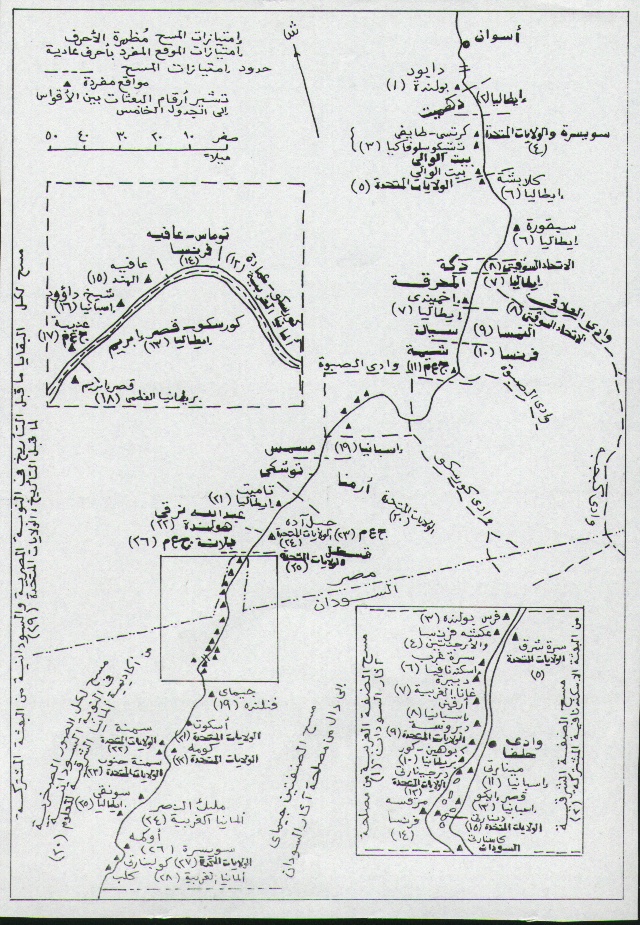
Map 1
The survey of Sudanese Nubia, organized in early 1960 with the assistance of UNESCO, eventually explored the entire extent of the Nile Valley between the Egyptian border and the entrance to the proposed reservoir (about 100 miles), leading to the discovery of more than a thousand sites and the excavation of more than a third of them. At the beginning of the survey, and in a few cases before that, about 18 concessions were taken by foreign missions (see Maps 1 and 2). Although the concession area covered less than a quarter of the total area threatened by submergence in Sudanese Nubia, it included most of the edifice sites and many of the major cemeteries. In addition, there was survey work other than that carried out by the Sudanese Antiquities Service. A Scandinavian group conducted a comprehensive exploration of one part of Sudanese Nubia, and at the same time excavated all the basic sites in that part. Other specialized surveys of the entire region were devoted to recording rock inscriptions and drawings and studying the remains of the Stone Age.
Because of its unique position of remaining responsibility, it was necessary for the Sudanese Nubia Survey to remain closely in touch with the work of other missions, and to support it wherever necessary. Over the years, a central register was maintained in Wadi Halfa in which the results of the work of each mission were recorded during its progress. In its own work, the survey conducted by the Antiquities Department decided to focus on those periods and those types of remains that had not been paid attention to by other missions, thus confirming that at the conclusion of the Nubian campaign, the various parts would be collected in some form of a connected whole.

Map 2
While the High Dam was bringing down the curtain on the book on Nubia, it was at the same time opening a new chapter in the study of the antiquities of Upper Nubia. Through their participation in the rescue campaign, many archaeologists got their first glimpse of the luscious lands south of the Second Cataract, many of whom now hold excavation concessions in other parts of Sudan. The Meroe cities of Musawwarat and Meroe, the ancient medieval capital of Dongola, the temples of Salib and Sadanga, and the great fortress of Sai, were all subjected to excavation in the years following the High Dam, and other expeditions were expected to come to Upper Nubia. Interest in this long-ignored area can only multiply as its archaeological promise becomes more well-known and the alternative of working in Lower Nubia no longer exists. The reader of this book should therefore be prepared for important additions to the story at any time. Sai Castle
Overall, archaeologists have the right to look back on their achievement in Nubia with great pride. The record they have been able to uncover in three-quarters of a century is in many ways more complete than that provided by history recorded in 1900. However, huge gaps remain. Systematic reconnaissance, and hence organized knowledge, has always been confined to those spaces that were destroyed by successive Aswan dams - Lower Nubia and Batn al-Hajar. The evidence indicating residence in this area, although extensive and detailed, is still incomplete. Entire chapters—the so-called Second Group, the Napata Period, and equally the Late Medieval Period—appear to be missing.
Perhaps it is permissible for us to summarize the history of archaeological excavation in Nubia by saying that the field study here, as elsewhere in the world, went through three phases, which can be comfortably described as “random,” “selective,” and “holistic.” The random phase is characterized by a distracted and unscientific quest in search of artistic objects and hidden treasures. Such has been the sad fate of ancient monuments in all accessible parts of the world; Such activities in Nubia are mercifully few. Until the twentieth century, the region was too remote and unstable to attract anyone but the most die-hard antiques enthusiasts.
The beginnings of scientific archeology were heralded by increasingly systematic and precise excavations in a few selected sites, usually by large, well-equipped expeditions headed by professional scientists (not necessarily trained excavators). The sites that received attention in the “selective” phase of excavation were in most cases always the monumental artistic and royal monuments, above all temples, palaces, and royal tombs. Such remains are preserved only by a limited elite culture. Its excavation contributes immeasurably to the study of art history and family history, but at the same time it creates an incomplete and one-sided picture of the cultural development of an entire people.
“Holistic” archeology begins when attention shifts from the remains of monumental monuments to smaller, less thought-provoking sites, and an effort is made across the area to sample every type of site and every historical period. From such small pieces a more comprehensive picture of the cultures and cultural histories of all people gradually emerges.
In many parts of the world, the comprehensive stage of archaeological research has not yet been reached. In a few places, this stage came in the wake of the depletion of monumental sites based on the principle that there is no better than faute de mieux. In the vast majority of cases where holistic archeology has developed, it has been imposed on each archaeologist by the demands of salvage. Perhaps future excavators will recognize the emergence of salvage archeology in the eras following World War II as one of the most revolutionary developments in the history of their science. Within the framework of the current generation, this modern, comprehensive approach to excavation - which became necessary due to the great explosion in construction activity in the post-war years - has led to quantitative increases, and sometimes to radical revisions, in our knowledge of cultural history in many parts of the world. Surveying some of the huge areas destroyed by dams and reservoirs has forced us to think about culture and history, sometimes for the first time, in broad terms rather than in broad, regional terms rather than in the more traditional, narrow terms of site, city, and family.
The reader will realize that the majority of excavations conducted in Nubia before 1960 belong to the second or selective phase of the development of archaeology. This is especially true of the Harvard-Boston Expedition, whose work constitutes by far the backbone of Upper Nubia archeology to this day. Although the mission had an excavation concession that covered almost the entirety of northern Sudan, and was active in Medat almost every year from 1913 until 1932, its interests were entirely limited to the castles, temples, and major cemeteries of Upper Nubia. Thus, by far the excavations of six other major expeditions entered the field during the first half of the twentieth century.
If the excavations in Nubia were of a highly selective type, it must be recognized that this region was also in a sense the cradle of comprehensive archaeology. As mentioned earlier, the First Archaeological Survey (1907-1911) was the world's first rescue campaign, and it set the standard for many subsequent campaigns. Reisner's discovery and detailed description of the "cultures" of the First, Third, and Anonymous Groups, which he made within a few months of the campaign, stands as a vivid example of how comprehensive study can add more information to the incomplete picture that emerges from a study that confines itself entirely to archaeological remains.
Despite the questionable results obtained from the first archaeological survey, follow-up was relatively weak. Once the rescue operation was completed, archaeologists (including Reisner himself) turned back to their fascination with monumental sites, and for the next half century the only comprehensive excavation program undertaken in Nubia was that imposed by the expansion of the Aswan Dam (Second Archaeological Survey 1929-1934). The threat posed by the High Dam has of course resulted in a much more coordinated amount of action since 1960, as noted above. It is worth emphasizing that to date, no comprehensive survey or excavation has been conducted in any part of Nubia other than those areas that were flooded by successive Aswan dams, which are currently closed to any additional study. This point is of fundamental importance for understanding some of the gaps in the history that follows.
In doing so, Nubian archeology reached a comprehensive stage only in Lower Nubia and Batn al-Hajar. Throughout the vast region south of the Dal Waterfall - the ancient beating heart of Nubian civilization - we have not progressed beyond the selective stage. We can therefore present a logically complete and balanced picture of development only for those cultures and cultural stages that were well represented in the northern part of Nubia. Our treatment of the cultures of Upper Nubia - some of the most important in the history of the country - must often be general and speculative.
D.Dunham, Second Cataract Forts, vol.2. Uronarti, Shalfak. Mirgissa. Boston.
W.B.Emery, Preliminary Report of the Work of the Archaeological Survey of Nubia, 1929/30,- Annales du Service des antiquités de l’Egypte 30.
The ethnic and linguistic issue
Classical Writers│New Publications in Sudanese Studies│Bibliography│Sudanese Antiquities Exhibition│New Kush│Home Page